Rijkskantoor De Knoop

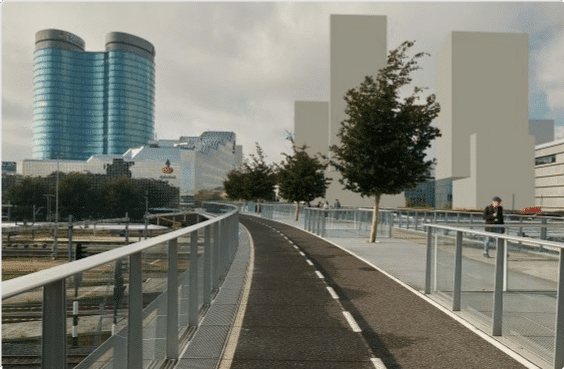
When Rijksvastgoedbedrijf (RVB) acquired the former Knoop barracks in Utrecht in 2011, it had the ambition to transform the area into a high-quality, mixed-use urban environment for working, living, and staying. In 2018, the first phase was successfully completed with the realization of a modern government office building.
Today, the RVB is working on the definition phase for the next development phases. This phase requires tough choices: about what will be built, when, and under what conditions. Choices that have direct consequences for planning, costs, and risks.
Why was BAEKEN needed?
Several strategic themes converge in the definition phase. Policy developments, area dynamics, and the divergent interests of stakeholders all influence the final scope. Themes such as mobility, energy supply, and possible residential functions influence each other and create uncertainty in terms of time and money. As long as the consequences of these choices are not explicit, the definition phase cannot be completed. The project needed additional guidance: not by dictating content, but by creating insight into the consequences of different scenarios. That is why RVB started a collaboration with Brink and BAEKEN.
The key question in this phase was clear: what exactly does the client want to have built, and what does that mean in concrete terms for schedule, costs, and risks? BAEKEN was brought in to bring structure to this decision-making process. By making choices explicit, quantifying uncertainties, and making scenarios comparable, the project team was given the basis to actually make decisions and determine the direction for the next phase.

How did we approach this project?
-
Clear definition of needs and guiding schedule
Together with the integrated project team, we first clearly defined which questions needed to be answered in order to complete the definition phase. For each strategic theme, such as mobility, energy, and programmatic choices, we determined what insights were needed to define realistic scopes.
Based on this, an integrated schedule was drawn up that does more than just organize activities. The schedule shows:
- which insights are critical for which decisions;
- when these insights must be available;
- where dependencies and decision moments are located.
In this way, the schedule serves as a steering tool for decision-making, rather than an administrative overview.
-
A risk dossier as a strategic tool
The risk register has not only been updated, but also actively used for scenario scheduling. Risks have been reassessed and quantified in terms of time, money, quality, and image.
This provided insight into:
- which scope tracks are structurally more uncertain;
- which scenarios are manageable within the current constraints;
- where cost or lead time overruns are already implicitly decided.
The risk dossier thus became a strategic tool: not only to manage risks, but also to enable realistic choices.
-
Probabilistic scheduling in Oracle Primavera Cloud
Deterministic scheduling is insufficient for complex development projects with many uncertainties. That is why probabilistic scheduling in Oracle Primavera Cloud (OPC) was chosen.[internalLink_open]Want to know the difference between deterministic and probabilitic scheduling? Read this article. [internalLink_close]
By linking the schedule to quantified top risks, decision-makers gained insight into:
- the range of lead times per scenario;
- realistic P80/P90 schedules (what is actually achievable);
- the cost implications of delays and risk buffers;
- scenarios in which the risk profile increases disproportionately.
The probabilistic model did not function as a technical exercise, but as a mirror: does this scope fit the ambitions, the budget, and the preconditions, yes or no?
-
Result: substantiated scenarios that provide direction
By integrating content, risks, and schedule, a clear and comparable range of scenarios was created. No abstract options, but concrete choices with visible consequences for time, money, and feasibility.
This enables the RVB to complete the definition phase carefully and responsibly. With transparent, factual scenarios, the project can enter the next phase with confidence, with clear choices and a manageable risk profile.
What has been used?

Oracle Primavera P6
Setting up the integrated schedule for the definition phase.

Oracle Primavera Cloud (OPC)
Probabilistic analysis of top risks to the schedule.

Risk Challenger
Recording, analyzing, and managing risks.

Curious if we can do something for you? Or check out similar projects.
Of bekijk andere projecten
Business Park @ Aviolanda
Business Park Aviolanda houses companies and training institutes in the field of aircraft engineering and maintenance.
Sustainable energy use @ Croonwolter&Dros
Commissioned by Vattenfall, Croonwolter&Dros is realizing the heat station “De Sleutel” (The Key) near Leiden, alongside
Lighting and Traffic Management Systems @ Vialis
Since October 1st, 2021, Vialis, commissioned by Rijkswaterstaat, has been replacing various technical systems under the